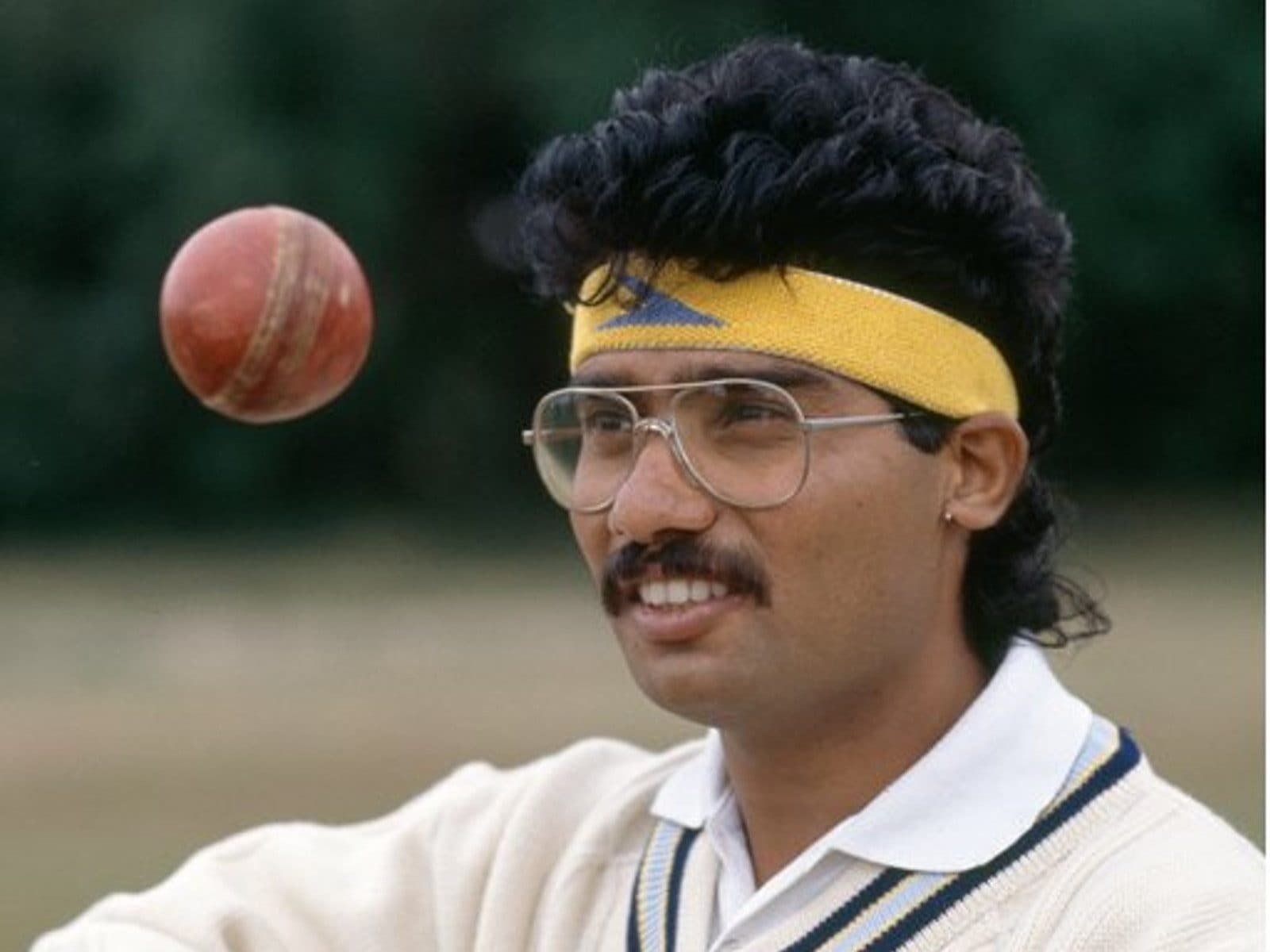
Narendra Hirwani stands as one of the most intriguing figures in Indian cricket history, a leg-spinner whose career is defined by an extraordinary explosion of brilliance on his international debut and a long, productive domestic journey.
Born on October 18, 1968, in Gorakhpur, Uttar Pradesh, into a Sindhi Hindu family, Hirwani grew up far from the traditional cricketing hubs. His father owned a brick factory, providing a stable but non-sporting background. Yet, young Narendra developed a passion for cricket early, playing informal games with a cork ball and honing his leg-spin skills through sheer determination.
He made his first-class debut for Madhya Pradesh in the 1984-85 season and quickly established himself as a prolific wicket-taker on spin-friendly domestic pitches. Over a remarkable 23-year first-class career spanning 167 matches until his retirement in 2005-06, Hirwani claimed 732 wickets at an impressive average of 27.05. He was particularly dominant for Madhya Pradesh in the Ranji Trophy, where he exceeded 400 wickets, cementing his status as one of the state’s all-time great bowlers. Later, in the 1996-97 season, he briefly represented Bengal, taking 29 wickets at 23.13.
Hirwani’s international breakthrough came dramatically. At just 19 years old, he earned his Test cap (No. 180 for India) in the fourth and final Test of the 1987-88 home series against the mighty West Indies at the M.A. Chidambaram Stadium in Madras (now Chennai) on January 11, 1988. The pitch was underprepared and spin-friendly, favoring the hosts after India won the toss and posted 382.
What followed was one of the most sensational debuts in Test cricket history. In the first innings, the bespectacled leg-spinner ripped through the West Indian batting lineup, claiming 8 wickets for 61 runs in 18.3 overs. His victims included legends like Viv Richards (clean-bowled by a googly he failed to pick), Richie Richardson, Carl Hooper, Gus Logie, Jeff Dujon, Clyde Butts, Courtney Walsh, and Winston Benjamin. This made him only the fourth bowler ever to take eight wickets in an innings on debut.
West Indies were bowled out for 184, trailing by 198. In the second innings, chasing 416, they crumbled again under Hirwani’s relentless variations—googlies, flippers, and flighted leg-breaks. He added another 8 for 75 in 15.2 overs, dismissing players like Phil Simmons, Desmond Haynes, Viv Richards (again), and Carl Hooper, with many dismissals featuring sharp turn and stumpings off wicketkeeper Kiran More.
His match figures of 16 wickets for 136 runs remain the world record for the most wickets by any bowler on Test debut, surpassing Bob Massie’s previous mark of 16/137 from 1972. This haul powered India to a commanding 255-run victory, leveling the series 1-1 against a formidable West Indies side. Hirwani’s performance earned widespread acclaim, with Sunil Gavaskar praising his composure on a challenging “minefield” pitch.
Despite this dream start, Hirwani’s international career proved inconsistent. He played 17 Tests between 1988 and 1996, taking 66 wickets at an average of 30.10, with four five-wicket hauls (including two on debut) and one 10-wicket match. His economy rate of around 2.77 reflected his control. A notable feat came during the 1990 tour of England, where he bowled 59 overs unchanged at The Oval—the longest unbroken spell by any bowler in Test history—demonstrating his stamina even in less favorable conditions.
In limited-overs cricket, Hirwani appeared in 18 ODIs from 1988 to 1992, claiming 23 wickets at 31.26. He shone in the 1988 Sharjah tri-series against New Zealand and Sri Lanka, taking 10 wickets in three games (including 4/46 in the final), helping India win the trophy and earning Man of the Series honors. He was also part of India’s winning squad in the 1988 Asia Cup.
Competition from spinners like Anil Kumble, combined with variable overseas form and selection preferences, limited his opportunities after the early highs. His final Test came against South Africa at Eden Gardens in 1996.
Post-retirement, Hirwani transitioned into coaching and administration, serving as a national selector for the BCCI and mentoring young bowlers.
Narendra Hirwani’s legacy endures through that unforgettable Chennai debut—a moment of magic that etched his name into the record books forever—and his steadfast domestic excellence. In an era of pace dominance and evolving spin options, he remains a symbol of what raw talent and skill can achieve on the biggest stage, even if only briefly at the international level.